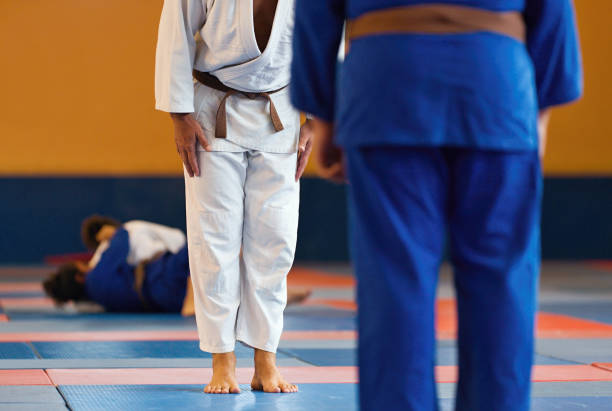
In the world of Judo, the floor is not just a surface you walk on; it is the single most important piece of safety equipment in the dojo. Unlike striking arts where the primary contact is with an opponent, Judo involves being thrown onto the ground repeatedly with significant force. This act of ukemi (breakfalling) puts tremendous stress on the body. Therefore, the quality of the flooring determines whether a student can train for decades or burns out with injuries after a few years. While thickness is often the first thing people check, the true secret to a safe landing lies in the density of your judo mats.
Density refers to how much foam material is packed into the mat’s core, usually measured in kilograms per cubic metre (kg/m³). It is a delicate balancing act. If a mat is too soft, it might feel comfortable to lie on, but it is dangerous for stand-up fighting. A soft mat absorbs too much energy when a judoka tries to pivot or drive for a throw, making movement sluggish and tiring. Worse, a soft surface can be unstable; as a foot sinks in, it can get trapped, leading to twisted ankles and blown-out knees during rapid directional changes.
On the other hand, if the mat is too hard, the shock absorption is compromised. Hitting a rock-hard surface repeatedly can lead to concussions, bruised ribs, and long-term joint issues. The “perfect” density sits in the middle. For most club and competition environments, a density of around 230kg/m³ to 270kg/m³ is considered the industry standard. This provides a firm enough platform for fast footwork and explosive movements but offers sufficient compression to absorb the shock of a high-amplitude throw like an Ippon Seoi Nage.
The core material of professional judo mats is typically a reconstituted compressed foam. This is different from the lightweight foam found in camping mats. Reconstituted foam is heavy, dense, and durable. It does not bottom out, meaning that even when a heavyweight player lands with full force, they will not feel the concrete subfloor beneath. This reliability is crucial for building confidence. Beginners are often terrified of being thrown. Knowing that the floor will catch them safely allows them to relax and learn proper breakfalling technique faster.
Another critical factor linked to density is the surface finish. Traditional judo mats feature a specific “tatami” texture a woven, straw-like pattern made from heavy-duty vinyl. This texture is not just for tradition; it provides the necessary grip for bare feet to push off without slipping, which is essential for generating power in throws. However, the vinyl must be bonded securely to the dense foam core. In cheaper mats, this vinyl can become loose or baggy over time, creating a tripping hazard. High-quality mats will have the surface fully adhered to the core and sealed at the corners to prevent moisture ingress.
Thickness also plays a role alongside density. The international standard for Judo is typically 40mm. This 40mm depth, combined with the correct density, provides the optimal critical fall height protection. Some clubs performing primarily groundwork (ne-waza) or hosting MMA classes might opt for 50mm or softer mats, but for pure Judo, the 40mm standard density mat is king.
Finally, consider the longevity of your investment. Dense, heavy mats last longer. They resist warping and curling at the edges, which is a common problem with lighter, cheaper alternatives. A curled edge is a toe-breaking hazard that no dojo owner wants to deal with. By investing in high-density, professional judo mats, you are not just buying flooring; you are investing in the long-term health of your students, ensuring they can take the fall and get back up, throw after throw, year after year.